September 20, 2026
Elm has had a hard century in Britain. Dutch elm disease, carried from tree to tree by elm bark beetles, took out most of our mature elms, and much of what survives is young regrowth pushing up from old root systems. Those regrowth elms are worth looking after — and the beetles that spread the disease never went away.
Spotting beetle activity early gives you choices. Knowing how the insect lives gives you a way to work with elm rather than against it. What follows covers what elm bark beetle does, how to recognise the signs, and the practical steps that genuinely reduce the risk to your trees.
The beetle is the carrier, not the killer
Elm bark beetles are small, brown and easy to miss — a couple of millimetres long at most. Two species matter in Britain: the large elm bark beetle and the small elm bark beetle. Both specialise in elm. Neither bites people, and neither will wander onto your oak or ash.
The beetles themselves do modest damage: they bore into bark and wood in order to breed. The real problem is what they carry. The fungus behind Dutch elm disease produces sticky spores inside the beetles' breeding galleries, and adults pick those spores up on their bodies as they emerge. Before they settle down to breed, adults make short flights to feed at the crotches of young twigs on healthy elms. That feeding bite is how the fungus gets into a tree's sap stream.
Signs to look for
Elm bark beetle damage and Dutch elm disease symptoms are easy to confuse, and in practice you often see both together. Work from the twigs downwards.
In the canopy
- Wilting leaves in summer, often starting on one branch and spreading outwards
- Leaves turning yellow, then brown, and hanging on the tree rather than dropping
- Shoots flagging or drooping over at the tip — sometimes described as a shepherd's crook
- Dieback in the crown, with heavy new growth pushing out of the trunk or base
On the bark and in the wood
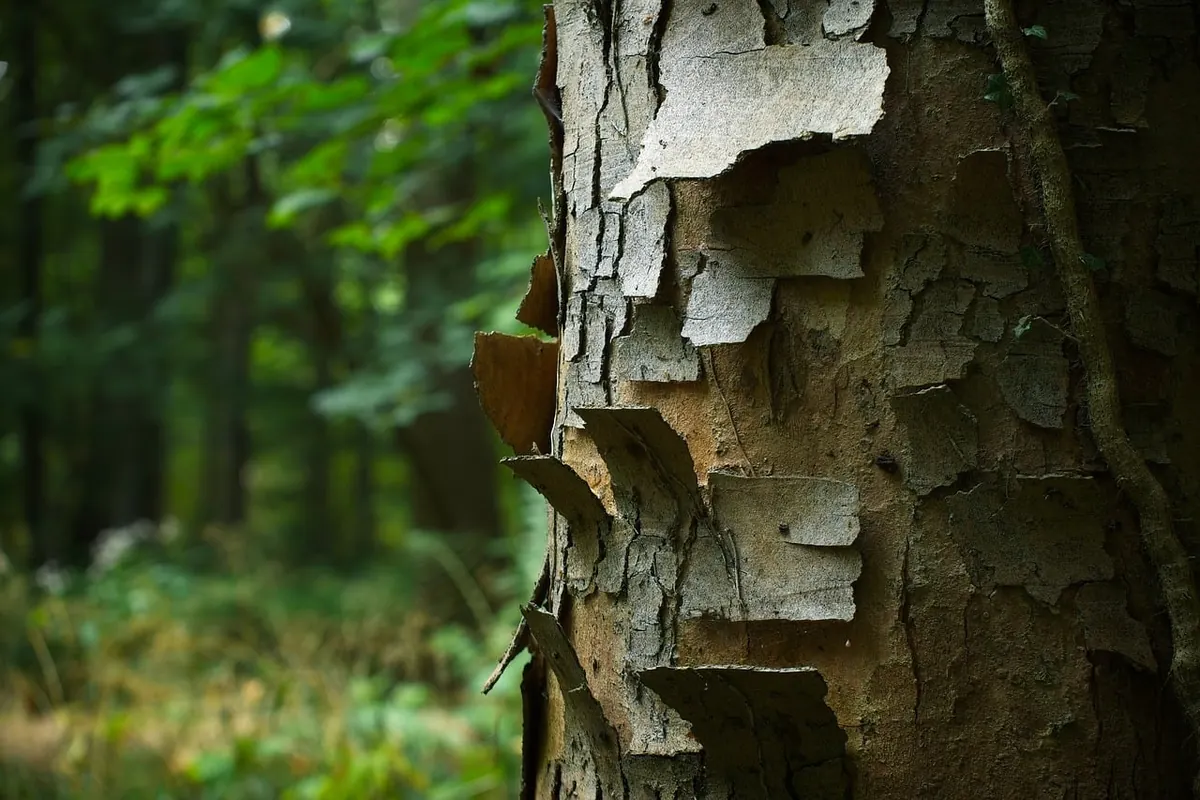
Look for small round holes, roughly one to two millimetres across, scattered over the bark like fine shot. These are adult exit holes. Around them you may see fine, sawdust-like frass caught in bark crevices, in branch forks or on the ground beneath. Bark that lifts away easily, with brown or black staining underneath, is another strong clue. Cut into a symptomatic branch and you may find dark streaking running through the wood.
Under the bark
Peel back a section of loose bark on dead elm and you may find the giveaway: a straight "mother" tunnel running with the grain, with short larval tunnels branching off it at right angles. The pattern looks like a fishbone or a small Christmas tree. That is the beetle's nursery, and it tells you the tree was used for breeding.
The lifecycle, and why timing matters
The beetle overwinters under elm bark as a larva or a young adult. Adults emerge in spring and early summer, feed briefly in twig crotches, then search out elm that is stressed, dying or recently dead — bark still attached, sapwood still damp. There the female cuts her egg gallery along the grain and lays eggs beside it. Larvae hatch and chew outwards, and the next generation of adults appears later in summer. In a warm year, a partial second generation can follow.
The practical takeaway is simple. Adult beetles are on the wing roughly from April to September and are most active in warm, still weather. Anything that creates a fresh wound on an elm during that window is an open door.
What makes a tree more vulnerable
- Drought stress — elms on dry, shallow or exposed ground struggle in a hot summer
- Root disturbance — compaction, excavation, new paving or building work over the root zone
- Fresh wounds — pruning cuts or storm damage during the growing season
- Nearby dead elm — stumps, fallen branches and stacked logs left in place
- Unmanaged hedgerow elm — stems left to grow thick instead of being cut on rotation
Practical steps to lower the risk
- Time your pruning. Cut elm in the dormant season, ideally late autumn to late winter, when beetles are not flying.
- Avoid wounding in the growing season. If a branch must come off in summer, keep the cut clean and remove the arisings the same day.
- Look after the roots. A mulch ring, deep watering during dry spells and no machinery over the root zone will do more for an elm than anything else.
- Clear dead elm material. Grind out stumps where you can. Burn, chip or debark logs and branches promptly rather than stacking them in a corner.
- Don't move elm timber about. Shifting firewood or logs to another site is one of the easiest ways to move beetles and fungus with them.
- Manage hedgerow elm. Regular cutting on rotation keeps stems small and reduces the dead and dying wood beetles like to breed in.
- Inspect in summer. A walk round in June and July, looking for wilting or flagging shoots, will catch problems while they are still local.
- Act quickly if symptoms appear. Prompt removal and proper disposal of infected material limits the risk to neighbouring elms.
If you suspect Dutch elm disease
Get a qualified tree professional or your local authority's tree officer to look at it before reaching for the saw. There is no practical way to cure a mature elm once the fungus is established, so the aim is usually to remove the tree before it becomes a breeding site, and to destroy the material rather than leave it lying about. If the tree may be covered by a Tree Preservation Order or sit in a conservation area, you will need permission before felling, so check first.
A long game worth playing
Elm is not finished in Britain. The regrowth elms along hedgerows and field edges are disease-tolerant in the way that teenagers are — small enough that the bark beetles prefer bigger, older stems. Keep those trees pruned on rotation, keep the root zone in good order, and keep an eye out in summer. That combination will not make your elms immune, but it stacks the odds in their favour, and the trees have plenty of time on their side.
Photo: ArWeltAtty / Pixabay