September 15, 2026
Common Pruning Mistakes That Harm Young Trees and How to Avoid Them
A young tree gives you a short window to get its shape right. The first five years decide whether you end up with a sturdy, well-proportioned tree or one that leans, splits or sulks in the border. Most pruning mistakes come from good intentions: a few snips feels like care, and it is often the opposite. Here are the errors that do the most harm to young garden trees, and what to do instead. Get these right and you will spend far less time correcting problems later.
Taking Off Far Too Much in One Go
A young tree is running a tight budget. Leaves pay for everything — roots, new wood, the ability to fight off pests and disease — so every branch you remove is income lost. Take off a little and the tree barely notices. Take off half and it will spend the next two seasons recovering instead of growing. The result is a smaller, weaker tree that takes longer to establish and is more vulnerable to drought and disease.
The signs of over-pruning are easy to read once you know them: a flush of weak, upright shoots from the trunk, few leaves, and very little extension growth the following spring. On a tree planted within the last year or two, even a modest trim can set it back noticeably. You may also see sunscald on suddenly exposed bark, especially on thin-barked species like maple, birch or cherry.
A sensible ceiling is around a quarter of the live canopy in a single growing season, and far less on a newly planted tree — think 10 per cent. If the tree needs more work than that, spread it across two or three years. Resist the urge to do all the shaping at once. A good rule of thumb: if you are removing more than a few small branches, stop and ask whether the tree will still have enough leaves to feed itself.
Whatever the season, these are always fair game:
- Dead, dying or broken branches
- Branches that rub against each other and have worn the bark
- Suckers from the rootstock at the base, and shoots growing from below the graft
Removing these does not count against your quarter, because dead wood is not paying its way and rubbing branches will only get worse.
Cuts Made in the Wrong Place
Where you cut matters as much as whether you cut. A young tree closes small wounds in a season or two; a badly placed cut can leave a wound it will never fully seal. The tree may survive, but it will carry a weak point for life, and that is exactly where it will split in a storm twenty years from now.
Flush cuts
Cutting level with the trunk removes the branch collar — the slight swelling where branch and trunk meet, which holds the tree's defences and seals the wound. The cut ends up bigger than it needs to be, and the tree has to work around the edges rather than closing it neatly. Always cut just outside the collar, with the blade angled roughly parallel to the branch bark ridge above. Think of the collar as the tree's own bandage; if you remove it, you leave the wound open.
Stub cuts
Leaving a length of branch beyond the collar is just as bad. Stubs die back, decay gets in, and the tree wastes energy trying to seal a wound that should never have existed. The dead wood becomes a landing pad for fungal spores and can allow rot to travel into the trunk. Always cut back to the branch collar or to a side branch that is at least one-third the diameter of the branch you are removing.
The right way to make the cut
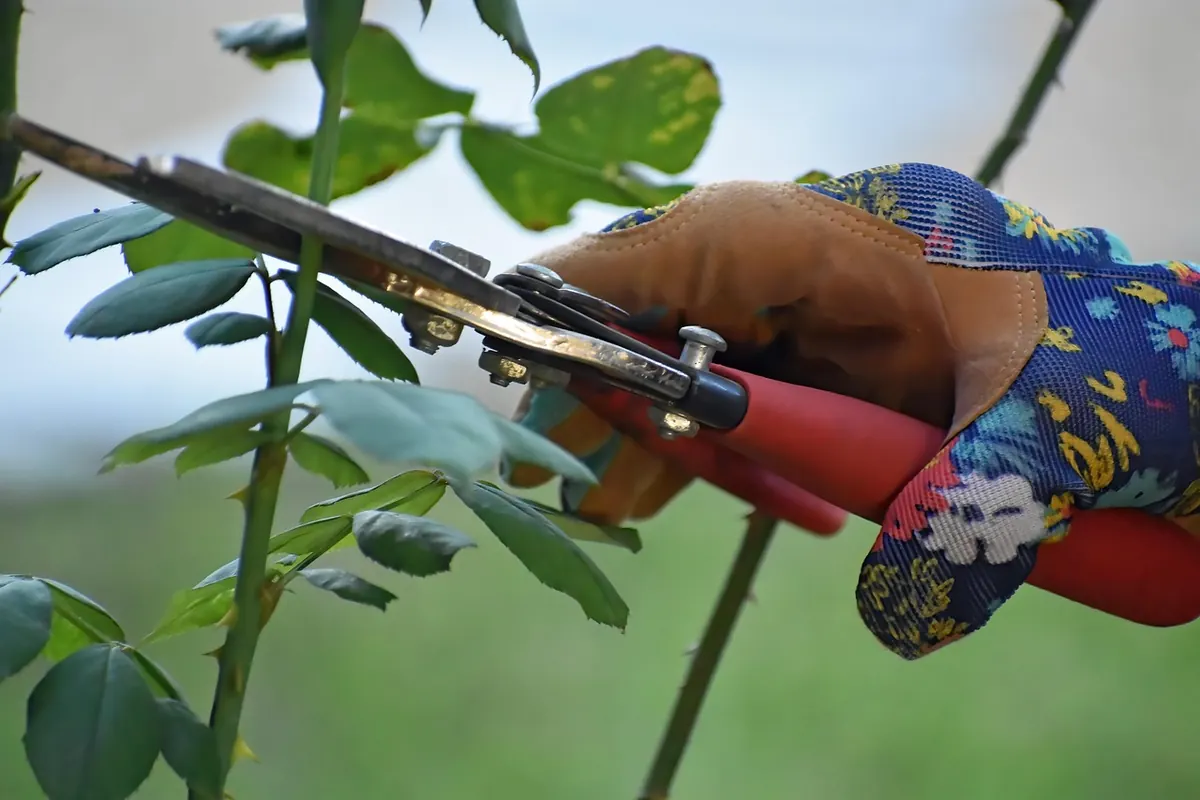
For any branch bigger than your thumb, use the three-cut method to avoid tearing bark. First, make a shallow undercut about 15 cm from the trunk on the underside of the branch. Second, make a top cut a few centimetres further out, so the branch falls away cleanly. Third, remove the stub with a clean cut just outside the branch collar. Do not paint the wound; the tree seals itself best in open air. Use sharp bypass pruners for stems up to finger thickness, loppers for branches up to about 4 cm, and a pruning saw for anything larger.
Pruning at the Wrong Time of Year
Timing is not just about convenience. Pruning triggers a growth response, and if you get the season wrong, you can push the tree into producing soft new shoots that will not harden before winter, or you can cut away the very wood that would have flowered next year.
As a general guide, the best time to prune most young trees is late winter or early spring, just before growth starts. The tree is dormant, the structure is easy to see, and it will heal quickly once it wakes up. Avoid pruning in autumn: the tree is shutting down, wounds heal slowly, and fresh cuts can be an open door for decay fungi.
There are exceptions. Trees that bleed heavily — maples, birches, walnuts and grapes — are best pruned in early summer after their leaves have fully expanded, or in late winter if you do not mind the sap. Stone fruits like cherry, plum and peach should be pruned in summer to reduce the risk of silver leaf and canker. And any tree that flowers on old wood, such as lilac or forsythia, should be pruned right after flowering so you do not remove next year's buds.
If you are unsure, remember this: the worst time to prune a young tree is whenever you are in a hurry. A little patience with timing will save you years of correction.
Failing to Train the Tree's Framework Early
Young trees do not need much pruning, but they do need direction. The first few years are your chance to choose a strong central leader, space out the main branches, and remove weak or badly angled limbs before they become large enough to matter. Waiting until the tree is ten years old means every cut is bigger, riskier and harder to heal.
Start by identifying the central leader — the main upright stem that will carry the tree's height. If two stems compete for that role, remove one of them while it is still small. Aim for scaffold branches that are spaced evenly around the trunk, ideally 15 to 45 cm apart vertically, and angled outwards at about 45 to 60 degrees. Branches with narrow, upright angles form weak unions that can split under snow or wind.
Codominant stems and included bark
The classic mistake is leaving a codominant stem — two stems of similar size growing from the same point. Over time, bark gets trapped between them, creating a condition called included bark. This is a permanent weak spot. The tree cannot seal it, and the two stems push against each other as they thicken, often splitting apart in a storm. If you see this on a young tree, remove one of the stems immediately, while the wound is small enough to close.
Also remove any branch that grows straight up through the centre of the tree, any shoot that emerges from the base of a scaffold branch, and any crossing branch that is already rubbing. These are small cuts now, but they prevent large problems later.
Pruning a young tree well is mostly about restraint. Remove less than you think, cut in the right place, choose the right season, and train the framework while it is still flexible. Do that, and the tree will do the rest.
The best pruning is the cut you do not make — and the second best is the one you make early, cleanly, and at the right time.
Photo: Ray_Shrewsberry / Pixabay